Thursday, March 28, 2013

TAJ MAHAL, INDIA


 Incredible India. That's the slogan of India tourism. Incredible means something that is difficult to be described, amazingly, does not make sense. India is as if tracing tracing wonders. Many amazing destinations. One is the Taj Mahal, in Agra city. The Indians called Monument of Love.

                                                     
Agra was the capital of the Islamic Empire centuries Mughol who ruled India. Empire was founded in 1526 AD to the invaders conquered England in 1857.

Taj Mahal is actually building the tomb. Taj Mahal is remembered as a symbol of love Shan Jehan, the fifth emperor of the dynasty Mughol, his wife, Mumtaz Mahal. Shan Jehan built the Taj Mahal in 1631 for the tomb of Mumtaz. His real name Arjumand Begum, Princess of Persia (Iran). After marriage, Arjumand was named Mumtaz Mahal, which means Jewel Palace.

Mumtaz is known for her beauty and attention to the poor. He was the idol of the people. Mumtaz died at the age of 39, when it gave birth to the 14th June 1631. This makes the death of Shah Jehan Empress were so sad. The time is widely used to pray and read the Qur'an at the tomb of Mumtaz.

Shah Jehan began construction of the Taj Mahal, six months after Mumtaz's death. Initially, the building was called the Shah Jehan as a 'mosque', where he prayed for the spirits of the Empress. The main building of the dome 57 meters, which is entirely composed of 28 types of marble rock was elected, was completed in 1648. But the entire Taj Mahal complex was built over 22 years. And Taj Mahal become the most popular tourist attractions in India.

Unlike other Mughol cemetery, park in front of the Taj Mahal. The background of Taj Mahal is sky, making it look so imposing building with gleaming white marble. Composition of the line shape and perfectly symmetrical.
                                   
Unfortunately, access to get there pretty hard. Nearest metropolitan city of Agra is New Delhi. The distance is about 200 km. There is a bypass road between New Delhi and Agra. But do not you imagine the main road was smooth. Instead, you'll find a bumpy road, a lot of holes and pools of water, nearly along the path to Agra. But it all paid off when we set foot in the Taj Mahal. It's incredible. Amazing.

Pictures of the Taj Mahal in miniature postcards that are sold or there is not enough to describe the legend, poetry, and romatinsme described by poet Rabindranath Tagore as India 'Tear Drops of Love An Emperor' it. You are not perfect in India if it does not visit to the Taj Mahal.

Sunday, March 24, 2013

PLITVICE LAKES NATIONAL PARK, CROATIA

Treat your eyes with beautiful views of Plitvice Lakes National Park, a place in Croatia with sixteen lakes in it are connected by a waterfall terraces with different heights. Highest waterfall is 1.280 m, while the lowest 380m.


Situated between the capital city Zagreb and Zadar, the National Park is a popular place among foreign tourists and has been named as a UNESCO World Heritage in 1979. In Plitvice Lakes National Park is located in a wooded area with a population of animals such as deer, bears, wolves, boars and rare bird species.

The park is open on weekdays and provide additional open longer hours in summer (7am-8pm). The entry fee is charged to visitors, will be used to maintain and protect the sustainability of the park.

Do not miss the exciting facilities are boarding the machine that will take you from one side to the other lakes of the largest lakes. Enjoy traditional dishes typical of the region Lika, Croatia, disebuah Licka Kuca restaurant (Lika House) located at the main gate of the park.


Not only in the summer of course you can visit the Plitvice Lakes, but any time in each season since the lake water discoloration. Even in winter this place was amazing to see with a sprinkling of snow on it.

Strictly forbidden to swim in the lake or any part of the park because it is heavily fortified lake water to clean.
              

ARDNAMURCHAN BEACH, SCOTLAND

Located on the Stunning West Coast of Scotland, Ardnamurchan is a long, narrow peninsula along the shores of Loch Sunart and includes the most westerly tip of the British Mainland. Ardnamurchan beach become the one of top tourist attractions in Scotland

Ardnamurchan is a peninsular full of wild and wonderful scenery on the west coast of Scotland. Point of Ardnamurchan, sticking out into the Hebridean Sea north of Mull, is the westernmost point in Scotland. The whole peninsula feels fittingly wild and remote, accessible only by one particularly long and winding road from Salen on Loch Sunart. Wildlife is all around, from golden eagles over the heights and whales and dolphins offshore. Explore moorland, forests, lochs and beaches such as the magnificent Sanna Bay.
  The stunning Ardnamurchan peninsula is the most westerly part of the British mainland and is quite literally the end of the road. This is a beautiful but unforgiving and remote corner of Scotland, with amazing seascapes at every turn. The harsh landscape is releived by a whole series of superb sandy beaches.
 

Things To Do In Ardnamurchan Beach

The great outdoors are here for you to explore with some of the best scenery on the West Coast of Scotland. Whether you are interested in walking, cycling, fishing or wildlife spotting, there's plenty to see and do.

If you just want peace and tranquillity, the air is so clear and the area so unspoilt, it is not difficult to find a corner somewhere that can become your own particular haven.

Festivals, Highland Games and many modern visitor attractions provide plenty of activity and entertainment in Ardnamurchan. there is some of the most challenging activity such as hill walking, climbing, cycling and skiing you will find in the whole of the UK.
                                           

Wednesday, March 20, 2013

ZERMATT, SWITZERLAND

 
 Zermatt is famed as a mountaineering and ski resort of the Swiss Alps. Until the mid-19th century, it was predominantly an agricultural community; the first and tragic ascent of the Matterhorn in 1865 was followed by a rush on the mountains surrounding the village, leading to the construction of many tourist facilities. The year round population (as of December 2011) is 5,746, though there may be several times as many tourists in town at any one time. Much of the local economy is based on tourism, with about half of the jobs in town in hotels or restaurants.

 The name of Zermatt, as well as that of the Matterhorn itself, derives from the alpine meadows, or matten (in German), in the valley. The name appeared first as Zur Matte ("in the meadow") and became later Zermatt.


Zermatt is known throughout the world for its skiing, especially Triftji for its moguls. The high altitude results in consistent skiing continuously throughout the summer.
Skiing in Zermatt is split up into four areas; Sunnegga, Gornergrat, Klein Matterhorn and Schwarzsee. There is also a connection to Cervinia and Valtournenche in Italy through the Plateau Rosa glacier.

 Near the southern end of Zermatt, the Matterhorn Express gondola transports passengers up to the interchange station at Furi. From here there is access to the Schwarzsee via a gondola to the right, a cable car that leads on to the Trockener Steg midstation (and then on to the Klein Matterhorn), and a new gondola, opened on 18 December 2006, links Furi to Riffelberg on the Gornergrat mountain. This lift addresses one of the most persistent criticisms of Zermatt: that it is very difficult to ski the two sides of the valley without a tiresome trek through the village between the Gornergratbahn and the Matterhorn Express at opposite ends of the town.


PANORAMA LANGKAWI, MALAYSIA

The Langkawi Cable Car or Panorama Langkawi Cable Car is one of the major attractions in Langkawi Island, Kedah, Malaysia. It provides an aerial link from near Burau Bay Resort at Teluk Burau to the peak of Gunung Machinchang, which is also the location of the Langkawi Sky Bridge. The total length is 2.2 km (1.4 mi). It was officially opened in 2003.

ATTRACTIONS

Base Station
The Base Station is located at the Oriental Village (at the foot hill of the Machincang mountain range). From the base, visitors will be taken up to the Machincang range via the Langkawi Cable Car on gondolas giving the visitors views of the surroundings forests, the Telaga Tujuh (Seven Wells) waterfall as well as the sea. The cable cars are closed weekly for maintenance.

Middle Station


Cable Car Middle Station
An intermediate Cable Car station on the eastern ridges provides access to the eastern cliffs with its 3 vertical chimneys and the 360-degree views.
The journey from the Base Station to Middle Station will cover 1,700 meters in length and upon reaching the Middle Station at an elevation of 650m above sea level, visitors will be able to alight and walk up to the viewing platforms.

Top Station


Cable Car Top Station
A short walk up the stairs from the Top Station will take visitors to the two viewing platforms at the top of Gunung Machinchang.


File:Langkawi Cable Car.JPG

Monday, March 18, 2013

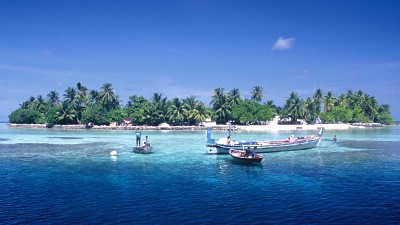
MALDIVES ISLANDS

Maldives, officially the Republic of the Maldives and also referred to as the Maldive Islands, is an island nation in the Indian Ocean consisting of a double chain of twenty-six atolls, orientated north-south, that lie between Minicoy Island (the southernmost part of Lakshadweep, India) and the Chagos Archipelago. The chains stand in the Laccadive Sea, about 700 kilometres (430 mi) south-west of Sri Lanka and 400 kilometres (250 mi) south-west of India.

The name Maldives may derive from mālādvīpa, in Sanskrit or maalai theevu (மாலை தீவு ) in Tamil. The Maldivian people were called Dhivehin. The word Dheeb/Deeb (archaic Dhivehi, related to Sanskrit dvīpa (द्वीप)) means "island", and Dhives (Dhivehin) means "islanders" (i.e., Maldivians). During the colonial era, the Dutch referred to the country as Maldivische Eilanden in their documentation, while Maldive Islands is the anglicised version of the local name used by the British, which later came to be written as "Maldives"


Maldives consists of 1,192 coral islands grouped in a double chain of 26 atolls, along the north-south direction, spread over roughly 90,000 square kilometres (35,000 sq mi), making this one of the world's most dispersed countries. It lies between latitudes 1°S and 8°N, and longitudes 72° and 74°E. The atolls are composed of live coral reefs and sand bars, situated atop a submarine ridge 960 kilometres (600 mi) long that rises abruptly from the depths of the Indian Ocean and runs north to south. Only near the southern end of this natural coral barricade do two open passages permit safe ship navigation from one side of the Indian Ocean to the other through the territorial waters of Maldives. For administrative purposes the Maldivian government organised these atolls into twenty one administrative divisions. The largest island of Maldives is Gan, which belongs to Laamu Atoll or Hahdhummathi Maldives. In Addu Atoll the westernmost islands are connected by roads over the reef (collectively called Link Road) and the total length of the road is 14 km (9 mi).
Maldives is the lowest country in the world, with a maximum natural ground level of only 2.4 metres (7 ft 10 in), with the average being only 1.5 metres (4 ft 11 in) above sea level, although in areas where construction exists, this has been increased to several metres. However, more than 80 per cent of the country's land is composed of coral islands that rise less than one metre above sea level.


Thursday, March 14, 2013

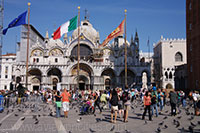
PIAZZA SAN MARCO, VENICE

Piazza San Marco is the principal public square of Venice, Italy, where it is generally known just as "the Piazza". All other urban spaces in the city are called "campi". 


Piazza San Marco was constructed in the 9th century as a small square dotted with trees. The square was laid out in front of the
Piazza San Marco, Venice
original St. Mark's Basilica, at the time a small chapel which was part of the Doge's Palace.

The square was separated from the palace by a small canal, the Rio Batario. Already a central gathering place for Venetians, the piazza was enlarged in 1174 after the canal and an adjoining dock were filled in. The square became paved with bricks in 1267 in a herringbone pattern. In 1735 the bricks were replaced with natural stone and laid in a more complicated pattern according to a design devised by architect Andrea Tirali. The design marked the location where

Procuratie Vecchie, Piazza San Marco, Venice     As the largest square in the city and the only one given the designation of "piazza" (the others are all referred to as "campi"), St. Mark's Square has always been the location of important government buildings and other facilities central to the goings on in Venice.

Venetian Pigeons

Pigeons at St Mark's Square, Venice
Feeding Pigeons
Besides being filled with people and great specimens of architecture, Piazza San Marco is also full of pigeons. Pigeons have long been a problem in the square but only recently did the city pass a law that banned the feeding of these birds. The pigeons have caused much damage to the delicate mosaics on St. Mark's Basilica and to other buildings around the piazza. Several attempts have been made to control the pigeon population but few have been even slightly successful.